How to get YOUR CHARITY cited in ChatGPT and Google's AI Overviews
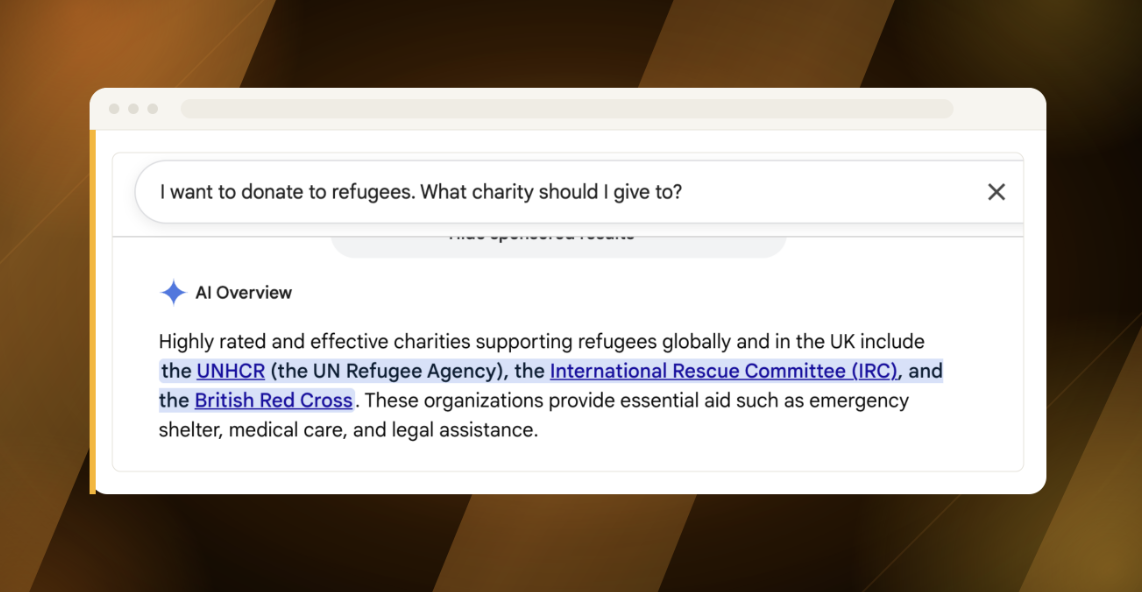
Open ChatGPT and type in the problem your charity aims to solve. Ask how to help, or who to support, and see what comes back. Usually, you'll get a calm, confident paragraph that lists a few organisations and moves on. The tough question is whether your charity is mentioned—and if it is, whether the information is even accurate.
This is the quiet change happening in search. For years, the goal was to move up a page of ten blue links. Now, there often isn't a page to climb. Instead, you get an answer the machine has already written, using sources it trusts. Google's AI Overviews show this at the top of the results. ChatGPT, Gemini, and Perplexity do it in place of traditional results.
In my last article about AI search and purpose-driven organisations, I explained that the game has changed. The goal is no longer to rank for clicks. Now, you want to be the source the AI trusts enough to mention. Being included in the answer is the new version of being on page one.
Here’s a practical guide on where I’d focus a charity’s limited time to build trust. Don’t worry about all the new terms like GEO or AEO. If you set aside the acronyms, it’s still the SEO you know, but now the goal is to be understood, trusted, and quoted by a machine, not just clicked.
Working definition
Generative Engine Optimisation
GEO is not a new discipline bolted onto SEO. It is the same work, aimed at a new reader: making your content clear enough to read, quotable enough to cite, and credible enough that an AI engine trusts it as the source of its answer.
Stop focusing on getting clicks. Start focusing on being quoted.
Clarity. Citability. Authority.
Every tactic below serves one of three goals: content a machine can read, content it can quote, and a source it already trusts. If a task doesn't move one of those three, it's busywork.
A common mistake is to treat AI search as just a tougher version of the same job. It’s not. You’re no longer just trying to rank; now you want to be the source an AI quotes when it gives an answer.
This change affects what good content means. Your content needs to be easy for a machine to read, easy to quote, and come from a source the machine already trusts. Every tactic below supports one of these three goals: clarity, citability, or authority. If a task doesn’t help with one of them, it’s just busywork.
Answer-first content is your biggest advantage, so begin with this.
Organise your content around the real questions people ask. Put a clear, complete answer in the first sentence or two under each heading, then add more detail afterward.
AI engines pick up clear, quotable sections. If your answer to "how do I leave a gift to charity in my will?" is hidden several paragraphs into a long page, a clearer page will get cited instead—even if it’s not as good as yours. Use question-based headings, start each with a direct answer, and write so a machine can pull out a full idea without needing the rest of the page.
A good test is to ask: could an AI quote this section by itself andbe correct? If not, make it clearer.
Make it absolutely clear who you are
AI systems rely a lot on trust. They prefer sources they see as real authorities on a topic. So, your job is to make it clear who you are and what you’re known for.
In practice, this means having a strong, authoritative About page; using your organisation’s name and description the same way everywhere; providing real author bios with true credentials; and making sure there’s a clear link between your brand and your cause. Using Organisation and Person schema helps machines understand this, instead of guessing.
Charities have a real advantage here. You have a clear mission, real expertise, and often a respected name—the exact things these systems look for. The key is to make your authority obvious, not to assume the machine will figure it out.
Publish the evidence only you have
AI engines love to cite original, clear evidence: statistics, research, or primary sources. This is your unique advantage, since charities have material no one else can share—like service data, sector benchmarks, lived-experience insights, frontline observations, and original research about your cause.
Turn this information into well-structured, quotable resources, andyou give AI something unique. Put numbers in tables or stat cards, clearly show where they come from, and make them easy to copy. This is how your audience insights move from internal reports to public authority signals.
Get the plumbing right.
All your hard work won’t matter if a machine can’t easily read yourpages. So, get the basics right: use one real H1 per page, organise headings clearly, make sure your pages are fast and work well on mobile, and use structured data like Organisation, Article, and FAQ to show what your content is.
One thing people often miss: make sure you’re not accidentally blocking the AI crawlers these systems use. It’s worth checking, because a single forgotten setting can keep you out of the answers completely.
Get cited on your own site, too.
AI systems pull information from the whole web, not just your site. Being mentioned by other trusted sources is a strong sign that you’re worth citing—the modern version of a backlink.
This means doing digital PR, getting quoted in sector publications, building partnerships, and keeping a presence on trusted sites. Here’s a key point: when someone asks an AI for "the best charity fundraising consultancies in the UK," it creates a shortlist from third-party mentions and directories, not just your homepage. The more the wider web sees you as an authority, the more the AI will too.
Write the way people really ask questions.
People use natural, conversational language when they prompt AI—like "what's the best way to support refugees in the UK?" instead of "refugee support UK." So, answer the real questions your audience asks, using their words, and include the obvious follow-up questions.
The more your content matches how people ask questions, the more likely it is to be chosen as the answer. Listen to how your supporters really talk about your cause, and write in that style—not just using keyword tool phrases.
Measure your results, even if you have to do it manually.
You can’t manage what you don’t track, and AI visibility is harder to monitor than traditional SEO. Standard dashboards don’t show when an AI quotes you, and clicks from AI features often don’t appear separately in your analytics. So, your current reports mix old and new behaviours together.
For now, the practical solution is to check manually. Each month, run your key queries through ChatGPT, Perplexity, Gemini, and Google’s AI Overviews. Note if you’re mentioned and if the information about your organisation is correct. That second point is crucial. For charities, public trust depends on people getting the right facts, so it’s important to catch any mistakes early.
The GEO checklist, at a glance
- Answer-first content: question-based headings, a direct answer up top, detail below.
- Entity authority: make it clear who you are and what you're known for.
- Original data and insight: publish the evidence only your organisation has.
- Technical hygiene: clean structure, schema, fast on mobile, no blocked AI crawlers.
- External citations: get mentioned by sources the AI already trusts.
- Natural question language: write the way people actually ask.
- Measure visibility: run your key queries through AI tools each month and check the facts.
What this means for charities
Here’s the good news. AI search rewards exactly what strong purpose-driven organisations already have: real authority, a clear mission, true expertise, and unique stories and data. The organisations that lose are those relying on thin, generic content that a machine can now sum up in a sentence. The winners are the ones the AI sees as trustworthy sources on their topic.
For once, substance matters more than budget. That’s a game charities can win, but only if they start now. The first step is to be clear: this is about taking action now, not waiting for AI search to settle.
If you want help making your organisation visible in AI search—from content structure to the insights that earn citations—this is the kind of work we do. Get in touch to get started.